Friday, February 24, 2006

The Grimm Truth behind Pigs and Razors

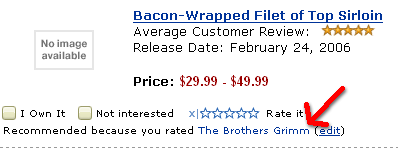
Behold, the wonders of Amazon's all-knowing Automatic Recommendation System, Extraordinaire (ARSE), from whence the Amazon gods pull their divine wisdom. Clearly I should suppress my doubts and seek one day to learn the lesson it seeks to teach me about myself. I will obey, lest it be angered and recommend to me harsher lessons, such as Skating With the Stars or Pickled Herring-Wrapped Filet of Haggis.


I mean seriously, did someone actually program it so that any movie with at least 5 blades in it gives Gillette a free ad? And I'm sure there were pigs and cows in the movie somewhere, but honestly. (Mind you, not that I'm at all averse to bacon and sirloin...)

Thursday, February 23, 2006

Cool Quote #6: Egil the Melancholy Viking

The sagas, so far ahead of their time, were prose stories about regular people, and often show an amazing insight into human nature and personality. Egil Skallagrimsson was an ugly, irascible, unpredictable Icelander, yet composed some of the most beautiful poetry Norse literature has to offer. Isn't it funny the combination of traits we often find in people? Anyway, check out this quote from Egilssaga:

As autumn progressed, Egil grew very melancholy and would often sit down with his head bowed into his cloak.

Once, Arinbjorn went to him and asked what was causing his melancholy: "Even though you have suffered a great loss with your brother's death, the manly thing to do is bear it well. One man lives after another's death. What poetry have you been composing? Let me hear some."

Now that's a man who understands melancholic personalities! :-D

Actually, it has been suggested that Egil suffered from Paget's disease. The saga says he had exceptionally broad bone structure in his head, disturbingly mobile eyebrows, and was generally in a bad mood. Also, Paget's disease would have given him a low-level headache all the time, as well as another unusual characteristic, useful to a Viking: when a farmer dug up his skull a century or so ago, the bone did not chip or shatter or break when he hit it with an axe, it just turned whiter.

The saga writer obviously had no access to the science that would have explained Egil's condition, but he did have access to a more general explanation: human nature, something the saga writers seemed very good at analyzing.

Sunday, February 19, 2006

Improve Your English

Berlitz commercial. I almost spit when I first saw this. Watch and laugh.

Saturday, February 18, 2006

Something Rotten in the State of ... Greece?

This is cool: sauvage noble posts his translation into Greek of Hamlet's To Be Or Not To Be speech.

Friday, February 17, 2006

Cool Quote #5: Beowulf

Continuing my pericopeal efforts to demonstrate the joys of Germanic literature, here's some Beowulf to tide you over til gaetanus' next installment. Frederick Rebsamen's updated translation has the two huge benefits of a) being a clear rendering in modern English, if a bit of a paraphrase (inevitable if you're not doing prose), and b) quite successfully following the rules of Old English (Old Germanic, really) poetic structure. You must read aloud this passage about the Danes first discovering the carnage left by Grendel, noticing the patterns of alliteration that bind the lines together:

At dawning of day     when darkness lifted
Grendel's ravage     rose with the sun.
The waking Danes     wailed to the heavens
a great mourning-song.     Their mighty ruler
lord of a death-hall     leaned on his grief
stooped in shadows     stunned with thane-sorrow
bent to the tracks     of his baneful houseguest
no signs of mercy.     His mind was too dark
nightfall in his heart.     There was no need to wait
when the sun swung low     for he slaughtered again
murdered and feasted     fled through dawnmist
damned to darkness     doomed with a curse.
(ll. 128-137)

Rebsamen has no problems using modern English to imitate the Old in creating new compounds like death-hall, bloodgrief, heartstrong, slaughter-maid, and hell-mother.

I'll post later about the poetic form common to all the old Germanic languages, but for now, here are the roughly corresponding lines of the original for comparison (audio link below):

Ðá wæs on úhtan     mid aérdæge
Grendles gúðcræft     gumum undyrne·
þá wæs æfter wiste     wóp up áhafen
micel morgenswég.     Maére þéoden
æþeling aérgod     unblíðe sæt·
þolode ðrýðswýð     þegnsorge dréah
syðþan híe þæs láðan     lást scéawedon,
wergan gástes·     wæs þæt gewin tó strang
láð ond longsum.     Næs hit lengra fyrst
ac ymb áne niht     eft gefremede
morðbeala máre     ond nó mearn fore,
faéhðe ond fyrene·     wæs tó fæst on þám.
(ll. 126-137)

this is an audio post - click to play

Thursday, February 16, 2006

Blog Translation Carnival

For those interested, ALTALK, the blog for the American Literary Translators Association (ALTA), has announced the Carnival of Blog Translation. See the link for details and rules, as well as a decription of the particular blog phenomenon known as the carnival. In short, pick any blog post that was posted in February (even among your own), and translate it. Into what? Into whatever you're qualified at, or interested in trying! Sorry, gaetanus, I don't know how many blogs you'll find in Coptic or Syriac... ;-)

(h/t to languagehat)

My Blog is Random and Different--Just Like Everybody Else's

[cynicism]
If you're new to blogging, you may still be fresh and innocent and think how wonderful it must be to have a venue for your random musings for all to read. If you've read any blogs other than those of yourself, your friends, and your neighbor's sweater-wearing chihuahua, you have likely found that approximately 70% of blogs maintained by actual people are self-described as 'random' or some essentially synonymous expression (see "stuff" in The Bitter Scroll's own subtitle). It's cute, in a wacky, slightly modern-rebellious kinda way. (Because, you know, not following the crowd is what everybody's doing these days.)

Unfortunately, what lacks in content will never be fully made up by form or medium of expression. The more readers who experience the wearing-off of the novelty of blogs, the more they will want some indication of content, some way to fit what you're likely to say into the vast hierarchy of knowledge and opinions. The more you leave it open, the more readers will fear pictures of pets or detailed descriptions of how you felt when you stubbed your toe yesterday.

The solution? Well, it depends if you think there's a problem, of course. If you really don't want to be heard--you just want to talk--blogging probably really is for you. (And easier on the rest of us. You can't click away from a RL conversation.) But if you want people to read your stuff, you need to give them a reason to read before they read. In the approximately 0.4 seconds in which they judge your blog worth it or not when they stumble across it, you need to convince people that your blog is worth reading. Then, of course, actually make worth reading.

I think we've got more than enough blue pills in the blogosphere. We could probably use a few more attempts to escape from the matrix of randomness and, ironically, uniformity.
[/cynicism]

Sunday, February 12, 2006

When Bureaucrats Try To Talk Linguistics

Don't know how I missed this post the first time (h/t to Månskensdans), but it really is funny. I can't wait to be asked if I have a native speaking knowledge of Etruscan or IndoEuropean -- or Quenya, for that matter.

I'm totally with Johan on this one (if I'm translating correctly): "Not that I need to, but now I know what I'll do next time someone questions the benefit of my learning Gothic." A Swede after my own heart.

Cool Saga Quotes #3 & 4: Think the Terrible Two's are Bad?

This one's just classic. It's from the famous Egilssaga:

When the time came for Skallagrim and Bera to go to the feast, Thorolf and the farmhands got ready as well; there were fifteen in the party in all.

Egil told his father that he wanted to go with them. "They're just as much my relatives as Thorolf's," he said.

"You're not going," said Skallagrim, "because you don't know how to behave where there's heavy drinking. You're enough trouble when you're sober."

Oh--did I mention that Egil was three at the time? In his defense, though, he was mature for his age:

As he grew up, it soon bcame clear he [Egil] would turn out very ugly and resemble his father, with black hair. When he was three years old, he was as big and strong as a boy of six or seven.

There. All better, right?

Learning from Linguistic Friendships

First off, Hejsan! to all my readers in Sweden, a whole bunch of whom seem to have gotten here by way of a link someone posted on a Swedish fantasy and RPG site. (Jag börjar lära mig svenska, och var glad att finna en intressanta sida där jag kan öva mig att läser.) Incidentally, Scandinavian readers of Tolkien are bound to recognize some of the Old English words and names of the Rohirrim that are lost on speakers of modern English. E.g., Gamling the Old, where gamol is simply the Old English for 'old', like the modern Swedish word gammal. Relationships like this come from the Norse influence on Old English (from Norwegians and Danes mostly) during the centuries before the Norman Invasion (9th to 11th).

Anyway, the main reason for posting has to do with a quote I remember reading about from either Tolkien or Lewis, I can't remember which. The gist of the quote was that not only were all of the Inklings friends, but that one's friendship with one person illuminated one's friendship with another. To wit: C. S. Lewis had a certain relationship with Tolkien, but it only went so far. But when others of the Inklings were around, he learned even more about Tolkien's personality by watching his interaction with them. Each person brought out a different facet of the personality of each of the others. As members of their circle left or died, Lewis (I think the quote was from him) found that his own friendship with Tolkien was affected as well, by being limited: He would never again be able to watch and learn from the interaction between Tolkien and, say, Charles Williams.

My little epiphany this morning came when I was reading (with extensive help of a dictionary) a Swedish-language blog (Månskensdans -- which now lists Bitter Scroll on his blog list; tack, Johan!). As I look up the word betyder and discover that it means 'to mean' (as in, "tack means 'thanks' in Swedish"), two thoughts rush into my head at the same time. The first is that it's got to be a cognate of German bedeuten: the 'eu' of German was a development from a ü-sound in Middle High German, and that sound is spelled 'y' in Swedish. The second is that betyder looks a lot like 'betide' -- admittedly a word no one uses anymore, but modern English speakers still recognize that the question "What will this betide?" is asking "What will this mean?"

I love moments like this. My short but growing relationship with my new friend, the Swedish language, has helped me form a closer bond with a much older friend, German. (Yeah, I know this sounds weird, but stay with me.) Readers may notice that I often speak of words and languages like members of a family: "These words are cousins, descendng from a common ancestor." ... "Gothic, and its younger Germanic siblings Old Saxon, Old Norse, Old English...", etc. I see the analogy even more clearly now. If you've ever gotten to know the family of a person you know well, you start to see the little ways they act in a new light, and you understand that person better. So it is with language families. If you really want to know a language thoroughly--why it has some of the expressions it does, why certain verbs are defective, why it forms words they way it does, even why it sounds the way it does--get yourself on a linguistic Family and Friends program. You'll never stop learning.